
Re-moralisation

Re-moralisation

Morality in the 21st Century has suffered massively from the philosophical chaos of the last 100 years.
 Yuri Bezmenov spoke about the ideological subversion of western culture, whether this has come about as a result of the nefarious designs of wicked individuals and entities or is the product of spiritual naiveté, ignorance, or ambivalence on the part of the masses – the result is the same – de-moralisation. De-moralisation is arguably the greatest spiritual malaise, even tragedy, of the philosophical chaos of the last century.
What is de-moralisation? De-moralisation is what happens when meaning is removed from our most important stories.
To remove the moral of a story is to remove its substance, and to reduce it to a garble of meaningless words. The moral we take from a tale is its spiritual essence, the guiding principle or maxim that can, and should, be taken from it. In a sense, the moral we take from a story is a type of bread for the soul – and when we absorb what it offers it provides us with moral strength – the courage to do the right thing. The great benefit that morals offer is they help us orient ourselves when faced with the many moral quandaries to which life is subject, and without them it is easy to become disoriented and ultimately lost in moral and spiritual darkness.
Without morality there can be no happiness, at least if you have a soul. A life without honour is no life at all, for honour is what accrues as a result of living by a moral code. Life without morality is like a story without a moral – a meaningless garble of sounds. Morals, then, not only help us to know what is right, but through our stories we can be morally strengthened with the courage to do the right thing.
From morality we learn what it means to be a good father, mother, sister, brother, kinsman, kinswoman, colleague or patriot. Based on the experience of the ages, and woven together out of countless stories, they offer insights into human nature and destiny. We are Storied Beings. We contextualise our lives in terms of stories. Stories teach us our place in our family, society, the world, and even the cosmos. We hunger for stories. We are sometimes so hungry we will even entertain bad ones. We pay to hear them, read them, watch them, and play them.
Whether our diet of stories is rich in nutrients or devoid of nutrition altogether, we still need them. Walk the streets and cast your eye upon your fellows and with a quick glance into the windows of their souls you can tell, in most cases, what kind of stories they consume. It’s hard to hide the stories you believe in. Our lives will inevitably reflect the stories we are drawn to. Whether we believe, in the end, that villains always win or that the meek inherit the earth sooner or later the stories we harbour in our hearts will cast their shadow across our lives.
The best stories weave together truth, beauty, and goodness. They give direction, meaning, and purpose to life and death. They reveal our place in the family – local, national, global, and cosmic. The best stories give us hope – something to strive for; while the worst can deprive us of hope – and leave us feeling life is not worth living. Stories, then, are a matter of life and death and it is in our interests, therefore, that we are discerning of the stories we accept. There is an onus upon us to find the best stories we can and use the insights we glean therefrom to construct for ourselves, and for those we love, the best lives we can.
Given that stories can be a matter of life or death, we need to be exceptionally discerning of where those stories come from. Stories have power, power to inspire, power to liberate, and power to enslave, power to drive insane. Not everyone understands how powerful stories are. Indeed, as Voltaire is reputed to have said: “Those who can make you believe in absurdities can make you commit atrocities.” Therefore integrity, health, happiness, and sanity all hinge on the stories we choose to believe. There can be little doubt but the best stories contain truth, beauty, and goodness but a living connection with such realities cannot be had without faith. Consequently, it would seem, the stories with the greatest value are spiritual ones – or stories that embrace spiritual truths – whose activating power is living faith.
Our faith stories are essential to our wellbeing, essential to our health, sanity and success in this thing called life and living. They provide the essential moral and spiritual guidance through which we can orient our lives and from which we appropriate direction, and even the truth upon which we gamble our very lives. The profound nature of the cultural shift in our present civilisation has made it difficult for many to connect with our ancient stories, having lost our connection with our most sacred stories - sense of the sacred has atrophied -we thus became spiritually unmoored, and fumbled into spiritual and moral darkness. The result of which is family in decline, crime is on the rise, while all governments and institutions have become utterly corrupted.
Part of the spiritual calamity in which this age finds itself is tied to the fact that truth cannot be found outside of faith. Philosophy can only offer probabilities, and probabilities simply cannot carry the weight of a life. We have been bamboozled by how smart and intelligent we are. We have, in a sense, entered an age of mind – much as a child transitioning from the naiveté and simplicity of early childhood discovers in adolescence greater abilities – only later to discover that ability and wisdom are not the same, and without wisdom - ability can do more harm than good.
One of the great powers of philosophy is its ability to analyse. However, proportion is required or else we lose sight of key contexts/frames/paradigms. Without proportion we can become disoriented and lost, and no longer be able to make sense of our experience. While our intelligence has grown and our inventiveness has been amplified, our wisdom has not. We marvel at our ability to produce but we are discovering that mere production is not an innate or inherent good, quality and purpose are important – otherwise the only thing breathtaking about our output is the prodigious amounts of rubbish we are capable of producing.
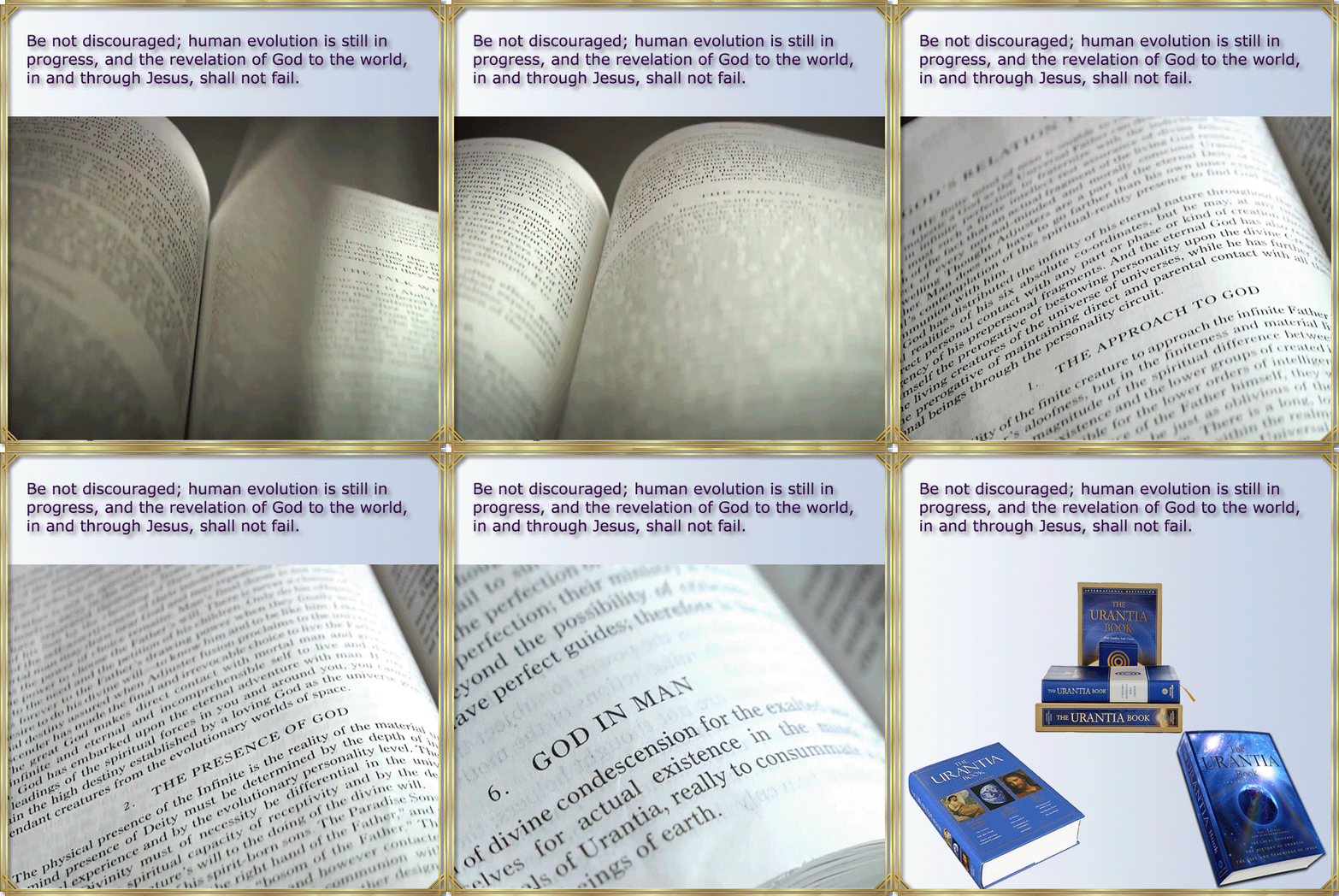
We need a new story. A story big enough to embrace the universe, and our place in it. A story filled with enthralling possibilities, endless wonders, new adventure, hope, and tantalising mysteries. A story that can help us move from demoralisation to re-moralisation. One that can provide us with a new perspective on the timeless and eternal values that persist from age to age, upon which great civilisations are built and by the light of which the allurements of glorious destiny are revealed! This new story can be found in the pages of the Urantia Book. Are you hungry for something more substantial?





Voices of the Prophets
Hi folks, The Voices of the Prophets is a forum whose purpose is to give people a venue to share AUDIO reflections, monologues, conversations, interviews, questions exploring what they have thus far learned and have yet to learn! We all lead such busy lives that it is sometimes hard to find 5 minutes to sit and read a newspaper much less something the size of the Urantia Book! In spite of these challenge, such is our spiritual hunger, we do find the time to satisfy the yearnings of our soul: while driving, doing our chores, or while going for a walk or run. All we need to do is download the talk or lesson that interests us, stick on our headphones or plug into our speaker, and listen away to our hearts content. Where there’s a will there’s a way! It is envisioned that the talks presented herein will be relatively unscripted; spoken from the heart. They might be monologues, conversations, songs of praise, whatever the spirit inspires you to share. It is hoped that the subjects discussed deepen insight, remove obstacles, resolve conflicts, enhance fellowship, and open the way for our spiritual cyber community to prosper. You are invited to provide comment, feedback, and questions to help explore and deepen the conversations.
Archives
Tag cloud
Barry Culligan, Voices of the Prophets, Strange Preacher, Strange Preacher Ministries, The Strange Preacher, Rebel without a Clue, Rebellious Reflections, The Rebellion and the Creator Son, War, Peace, Prophets, Love, Hate, Bo of Good Cheer, A WARNING TO THE POWER ELITE, ENOCH, Ezekiel, The Opening of the First Seal, The Conspiracy Theorist, Urantia Book, Urantia Papers, Publication, Mandate, 5th Epochal Revelation, A Tale as old as Time, Days of Tyranny, Revelations, Prophecy, The Kingdom of the Woke and the Revelation, Children of the Lesser Known God, On the current spiritual crisis, Shepherds Wanted, The Rising Mind Substack, Chad Gates, Ambassador of Christ, Human Teacher of Truth, The Language of Violence, Rebellion and Free Speech, Your Best Days Are Ahead, Morality in the 21st Century, Not Every Prophet in Scripture Was a Seer
Related blogs

Destiny
Their exists only one power in the Universe that...Children of the Lesser Known God
When our race on this troubled little sphere is...
Your Best Days Are Ahead
Your best days are ahead, they always were and...
Très beau texte, merci beaucoup mon frère Yuri. J’aimerais aussi vous partager mon point de vue sur ce qu’est le Livre d’Urantia. Pour ce faire, je vous recopie simplement un message que j’ai écrit sur notre groupe Telegram Download Divin :
« Bonjour tout le monde et merci Lucas pour le partage de cette excellente vidéo de Dolfo. En la réécoutant pour une seconde fois, une partie m’a particulièrement frappée: ” De quel réveil le monde ferait l’expérience si seulement il pouvait voir Jésus tel qu’il a réellement vécu sur terre et connaitre de première main ses enseignements donnant la vie ! ” La suite de cette citation est importante: ” Des mots décrivant de belles choses ne peuvent passionner autant que la vue de ces choses ; les mots d’un crédo ne peuvent pas non plus inspirer les âmes humaines comme l’expérience de connaitre la présence de Dieu. Cependant, la foi attentive gardera toujours ouverte la porte d’espérance de l’âme humaine pour laisser entrer les éternelles réalités spirituelles des valeurs divines des mondes de l’au-delà.” Tout cela m’inspire les réalités suivantes:
- le LU est bel et bien un outil d’éveil puisqu’il nous a été révélé de première main par certains de nos Amis invisibles